When a parent starts to need help getting up, washing, or preparing meals, the question of funding quickly arises. The personalized autonomy allowance (APA) is the main scheme to cover these needs. Compiling a complete APA file from the start avoids administrative back-and-forth and speeds up the receipt of assistance.
Online submission of the APA file: what digitization changes concretely
Recently, many departments have offered the option to submit and track your APA file directly on a departmental portal, sometimes via FranceConnect. Scanned documents replace postal photocopies. Notifications (missing documents, decisions, revision of the aid plan) are sent electronically.
This shift to digital reduces processing times for complete files. If your department does not yet offer this option, you can still obtain the form from the CCAS, the departmental council, or a local information point dedicated to the elderly.
Before filling out the form, gather the necessary documents in advance. To know precisely how to apply for APA with the complete list of required documents, take the time to check each document before sending.

AGGIR grid and GIR classification: understanding the evaluation that determines everything
The APA is not granted based on a simple declaration. The GIR classification conditions access to aid and its amount. This classification is based on the AGGIR grid (Autonomy Gerontology Group Iso-Resources), which measures the loss of autonomy through specific daily activities.
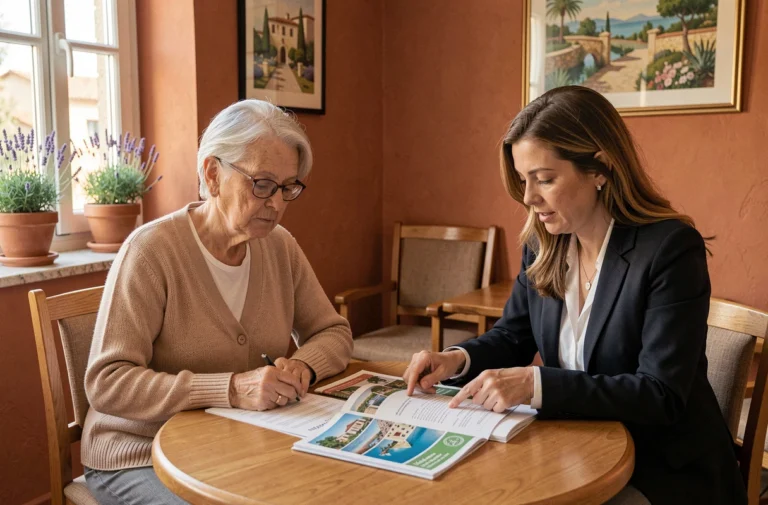
Specifically, a professional from the departmental council visits the elderly person’s home. They observe and assess their ability to perform tasks independently, such as moving around, dressing, eating, or communicating.
The GIRs eligible for APA
Only GIRs 1 to 4 are entitled to APA. GIR 1 corresponds to the highest level of loss of autonomy (bedridden person, severely impaired mental functions). GIR 4 concerns a person who needs help getting up, going to bed, or washing, but who can still move around their home.
People classified as GIR 5 or 6 are not eligible. However, they can seek other assistance from their CCAS or retirement fund.
How to prepare for the evaluation visit
Are you assisting a loved one in this process? The home visit is the key moment of the file. Do not minimize difficulties out of modesty or habit. Keep in mind one simple point: describe the bad days, not the best ones.
- Note in advance the daily tasks that pose problems (washing, dressing, meals, mobility, medication management)
- If the person has cognitive issues (disorientation, frequent forgetfulness), clearly mention this to the professional
- Prepare recent prescriptions and the medical certificate from the attending physician, as they support the evaluation
- If possible, be present during the visit to supplement your loved one’s responses
APA and home modification work: the connection with MaPrimeAdapt’
The APA at home primarily finances hours of human assistance and certain common technical aids. For more extensive work (Italian shower, stairlift, widening of doors), another scheme comes into play from January 1, 2024: MaPrimeAdapt’.
This aid, created by merging previous schemes managed by Anah, specifically covers the adaptation of housing for aging or disability. In practice, the autonomy services of the departments now require proof of a prior request for MaPrimeAdapt’ for significant work.
Why is this point useful when compiling the APA file? Because by anticipating the request for MaPrimeAdapt’ in parallel, you avoid a partial refusal of the aid plan regarding modifications. The APA aid plan then focuses on human assistance, and the two funding sources complement each other without duplication.

Processing times and common errors on the APA file
An incomplete file is the primary cause of delays. The departmental services must acknowledge receipt of the file and then have a regulatory period to organize the evaluation visit and notify the decision.
The most frequently missing documents
- The recent medical certificate from the attending physician, sometimes confused with a simple prescription
- The latest complete tax notice (the household income is used to calculate the beneficiary’s financial contribution)
- An up-to-date proof of residence, especially if the person has recently moved
Each missing document triggers a correspondence exchange and delays the decision. Check the list specific to your department, as some require a bank account statement in the name of the beneficiary and not in the name of the caregiver.
Revision of the aid plan after allocation
The APA is not fixed. If your loved one’s health condition changes, you can request a revision of the aid plan from the departmental council. A new evaluation visit will be organized to reclassify the GIR if necessary. This process also works if needs decrease, which can modify the financial contribution.
Compiling a solid APA file relies on three things: gathering the required documents before filling out the form, preparing for the evaluation visit without minimizing difficulties, and anticipating complementary schemes like MaPrimeAdapt’ if work is planned. A complete file from the first submission remains the best way to shorten the wait.